

Your environmentOn-premises, sovereign cloud or approved frontier models.
Enterprise agentic systems
Bring AI agents into your enterprisewith confidence.
We combine deep business-process knowledge, rigorous agent engineering and built-in governance to deliver dependable agents across the systems your organization already runs.
Client-ownedHuman-controlledAuditableBuilt for continuity
Your rulesPermissions, policies and approval boundaries built in.
Your oversightHuman control, monitoring and clear audit trails.
Your ownershipArchitecture, documentation and knowledge remain with you.
I Why enterprises choose us
Enterprise experience changes what gets built.
Building a prototype is fast. Making it dependable across real workflows, permissions, systems and exceptions takes enterprise engineering. That is where our work begins.
We begin with the work, not the model.
We learn the real decisions, handoffs, controls and exceptions before introducing automation.
Built around the systems you already trust.
We connect agents to ERP, CRM, data and inherited applications while respecting identity and transaction integrity.
Your people remain in control.
Every agent has clear permissions, approval points and escalation paths aligned with your policies.
We stay with you through production.
We monitor, improve and transfer the operating knowledge your team needs for long-term ownership.
II The production framework
Confidence comes from the system around the intelligence.
The model is one component. Dependable agentic AI combines process knowledge, thoughtful architecture and operating discipline so intelligence can create value within clear boundaries.
The Agent MandateRequired before production
Every agent begins with a clear mandate.
Before an agent acts, its mandate makes the expected outcome, permitted authority, human oversight and evidence of performance clear to everyone involved.
Mission and measurable outcomePermitted systems, tools and dataApproval and escalation boundariesEvaluation and release thresholdsAudit, rollback and recovery proceduresNamed operational ownership

Process engineering
Rules, exceptions, controls, handoffs and business outcomes.
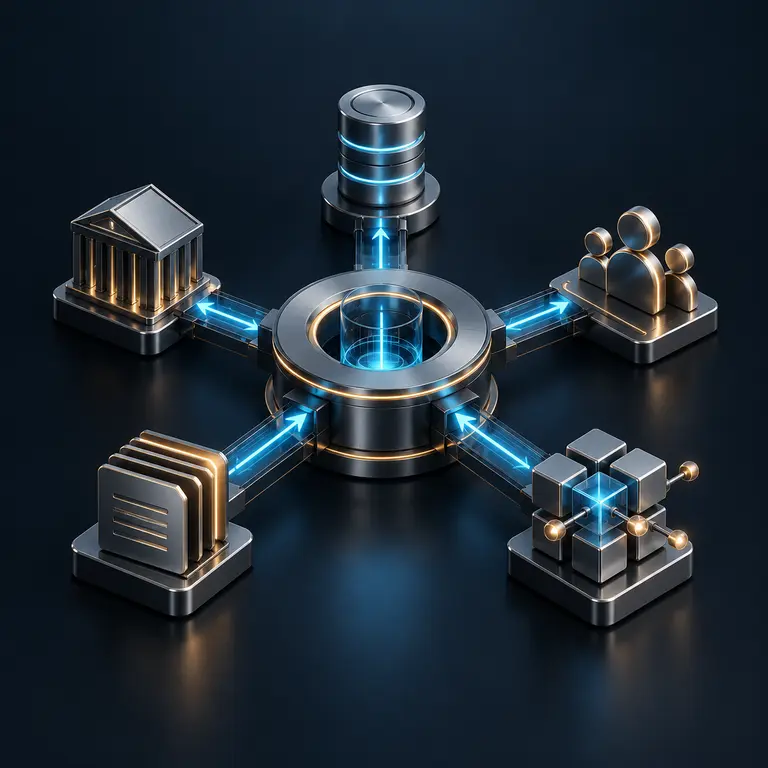
Enterprise integration
ERP, CRM, documents, APIs, identity and inherited systems.

Assurance by design
Evaluations, policy enforcement, human approvals and controlled releases.

Long-term operation
Observability, support, recovery and continuous improvement.
III Solutions
The products reach from where work begins to where it is recorded.
Six products form two layers, reaching from where work originates to where it is recorded. The frontier layer covers five surfaces — the enterprise record, the customer boundary, the physical boundary, the facility and the executive; and the connective layer reaches neighbouring systems of record. Together, they allow an agent to move from a camera frame or a customer message to a posted journal entry, under one governance model, inside infrastructure the client controls.
Operating edgeInstitutional systems
Frontier models
Five surfaces — the enterprise record, the customer boundary, the physical boundary, the facility and the executive.

ATLAS
The record of what happened.Agents operate inside the ERP across finance, payroll, administration and assets. An agent that posts a journal entry holds authority over the books, so every Atlas agent works under an approval threshold, a value limit and an immutable log.

CALYPSO
The customer boundary.Agents operate across the customer lifecycle: omnichannel contact, resolution, service, intelligence, loyalty, order tracking and fulfilment. An agent able to issue a refund or a credit holds a budget, and operates under a per-case limit, an aggregate limit and a defined escalation path.
ARGOS
The physical boundary.Multimodal analysis of camera and sensor data operates across a facility, with monitoring, alerting and control. Video from a ward, a branch or a clean room is the workload that most clearly cannot leave the building, so Argos runs on premises by default.
HESTIA
The operational layer.Facility management agents work across support, maintenance and operations, with a visualisation layer. Argos detects the anomaly, Hestia triages and dispatches with the right parts and permissions, and Atlas records the labour and cost against the asset.

MENTOR
The executive boundary.A persistent agent on the principal’s own machine. It holds the thread of the week, prepares briefings, tracks what was asked for and of whom, and assembles analysis on demand by reaching through Odyssey into the systems the institution already runs. It holds exactly the principal’s own permissions and not one object more.
Connective
Libraries reach neighbouring systems of record.

ODYSSEY
The reach into everything else.MCP libraries connect Atlas to core banking, hospital information systems, student information systems and adjacent platforms. Each library is published with its own permission scope: which objects it reads, which it writes, under whose identity, with what escalation.
IV Deployment boundaries
Deploy with the level of control your institution requires.
Sovereignty is a control model, not simply a hosting location. Together, we select the model, infrastructure and operating boundary that fit your data, policies and operational needs.
On-premises
Agents and selected models operate inside infrastructure controlled by your organization.
- Maximum isolation
- Customer-controlled data and keys
- Open-model flexibility
Federated
Each department operates separate agents and infrastructure within its own technical and data boundary, under a shared institutional governance model.
- Department-owned infrastructure
- Shared identity and policy
- Controlled interdepartmental exchange
Sovereign cloud
Dedicated or approved in-country infrastructure with explicit residency and operational controls.
- Jurisdictional control
- Managed infrastructure
- Regulated workload support
Managed frontier
Managed frontier intelligence—including Anthropic models—where policy permits and capability matters most.
- Frontier reasoning
- Rapid deployment
- Governed data access
V Customer mandates
Operational intelligence, delivered inside defined boundaries.
Three mandates across regulated banking, large-scale facilities and omnichannel retail. Each combined probabilistic reasoning with deterministic control inside the systems the customer already operated.
Banking
Governed intelligence across banking systems.
Atlas + Calypso + Odyssey
Within this bank, data was siloed across multiple systems of record. Enterprise knowledge graphs and reasoning workflows required ordered access, explicit permissions and clear operating rules.
Atlas governed actions within systems of record, Calypso handled customer-facing reasoning, and Odyssey enforced tailored gates and guardrails across more than 15 critical core-banking applications. Their controlled orchestration combined contextual reasoning with deterministic rules to provide governed operational intelligence.
Next phase
Supervised execution with human intervention at selected decision points.
Ordered access architecture
Large-scale facilities
Multimodal operations across a large-scale facility.
Argos + Hestia
Within this large-scale facility, more than 1,000 cameras and 200 sensors were already deployed. Argos introduced a multilayer, multimodal agent stack that transformed video and sensor streams into structured metadata, verified alerts and permitted operational behaviour analysis.
In parallel, Hestia combined probabilistic agents with deterministic rules to replace more than 50% of defined monitoring-centre functions. The next phase extends selected Argos agents into physical AI through controlled testing on humanoid platforms.
Next phase
Controlled testing of selected Argos agents on humanoid platforms.
Multimodal operating field
Omnichannel retail
Omnichannel customer resolution.
Calypso
For this online and brick-and-mortar retailer, Calypso rolled out an extensive omnichannel customer-service operation in local languages. It coordinated digital and in-store interactions across the customer journey.
Calypso reduced time to resolution by 90% and cost per resolution by half.
One resolution layer
Time to resolution−90%
Cost per resolution−50%
Most Valuable Agent
Let’s discuss your Most Valuable Agent (MVA).
In a focused conversation, we will identify a valuable workflow, clarify its systems and boundaries, and define a practical path toward your first dependable agent.
Discuss a workflow